Restore vs Replace: Your Boat Seat Might Not Be a Lost Cause
Recover or replace your boat seat? A Florida guide from Venice, FL on cracked vinyl, waterlogged foam and rotted bases, with a checklist and comparison table.
· Updated · 7 min read · Venice, FL
Every boat owner on the Gulf Coast eventually faces the same question. The vinyl is cracked, the foam squishes and stays wet, the seams are letting go, and the cushions smell like a locker that has not been opened since August. Do you recover the seats you have, or throw them out and buy new?
If the cushions are torn, faded or waterlogged, do not haul them to the curb just yet. In most of the boats that come through our shop in Venice, FL, the seat is not a lost cause. Boat seat recovering is usually the smarter and more affordable route, and it often produces a better seat than the one the factory installed.
What actually goes wrong with boat seats in Florida
Before deciding anything, it helps to understand what kind of damage you are dealing with. The failures we see most often are:
- Cracked or sun-damaged vinyl. UV breaks down the vinyl's surface until it chalks, stiffens and splits, usually along the seams and the front edge where knees and legs rub.
- Foam breakdown and water absorption. Open-cell foam soaks up rain and spray like a sponge, then slowly collapses and grows mildew from the inside.
- Loose stitching and ripped seams. Ordinary thread rots in the sun long before the vinyl fails. A seat with good vinyl and failed thread looks worse than it is.
- Mold and mildew. Humidity plus trapped moisture plus a cover that does not breathe equals black spots that will not scrub off.
- Faded color. Years of sun turn navy to purple and white to yellow, even when the vinyl is otherwise intact.
Here is the key point: every one of those problems lives in the cover and the foam. If the seat frame and base underneath are still solid, there is a very good chance the seat can be restored to like-new condition while keeping the original fit.
What boat seat recovering actually involves
"Recovering" sounds like slipping a new cover over an old seat. Done properly, it is closer to a rebuild.
- Strip and inspect. We remove the old vinyl and foam and look hard at the base, the frame, the hinges and the mounting points. This is where we find out whether restoration makes sense.
- Foam. Tired or wet foam is replaced with closed-cell marine foam or high-density foam cut to the original profile, often with a moisture barrier so the new foam stays dry.
- Pattern and sew. The new cover is patterned from the seat and sewn in marine-grade vinyl with UV-resistant thread. This is where you choose colors, two-tone panels, diamond stitching or a tape edge finish.
- Fit and fasten. The cover is pulled tight and fastened to the base with stainless hardware so it will not rust-streak or let go in a year.
- Reinstall. The seat goes back on the boat on its original base, which means the original fit and the original mounting are preserved.
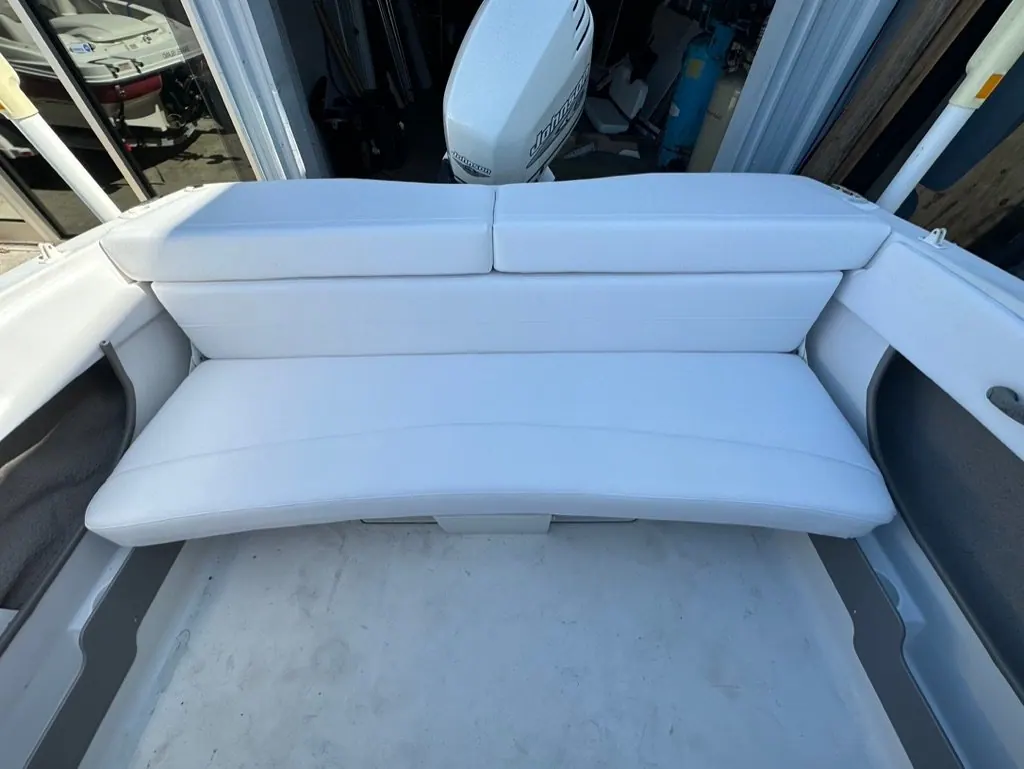
The case for restoration
It costs a fraction of replacement
The expensive, hard-to-find parts of a boat seat are the base and the frame, and recovering reuses both. Replacement seating, especially custom or OEM seats for a cruiser or a pontoon, can be a serious expense. Restoration typically costs a fraction of that, and you keep complete control over materials, stitching and design.
You are not stuck with factory options
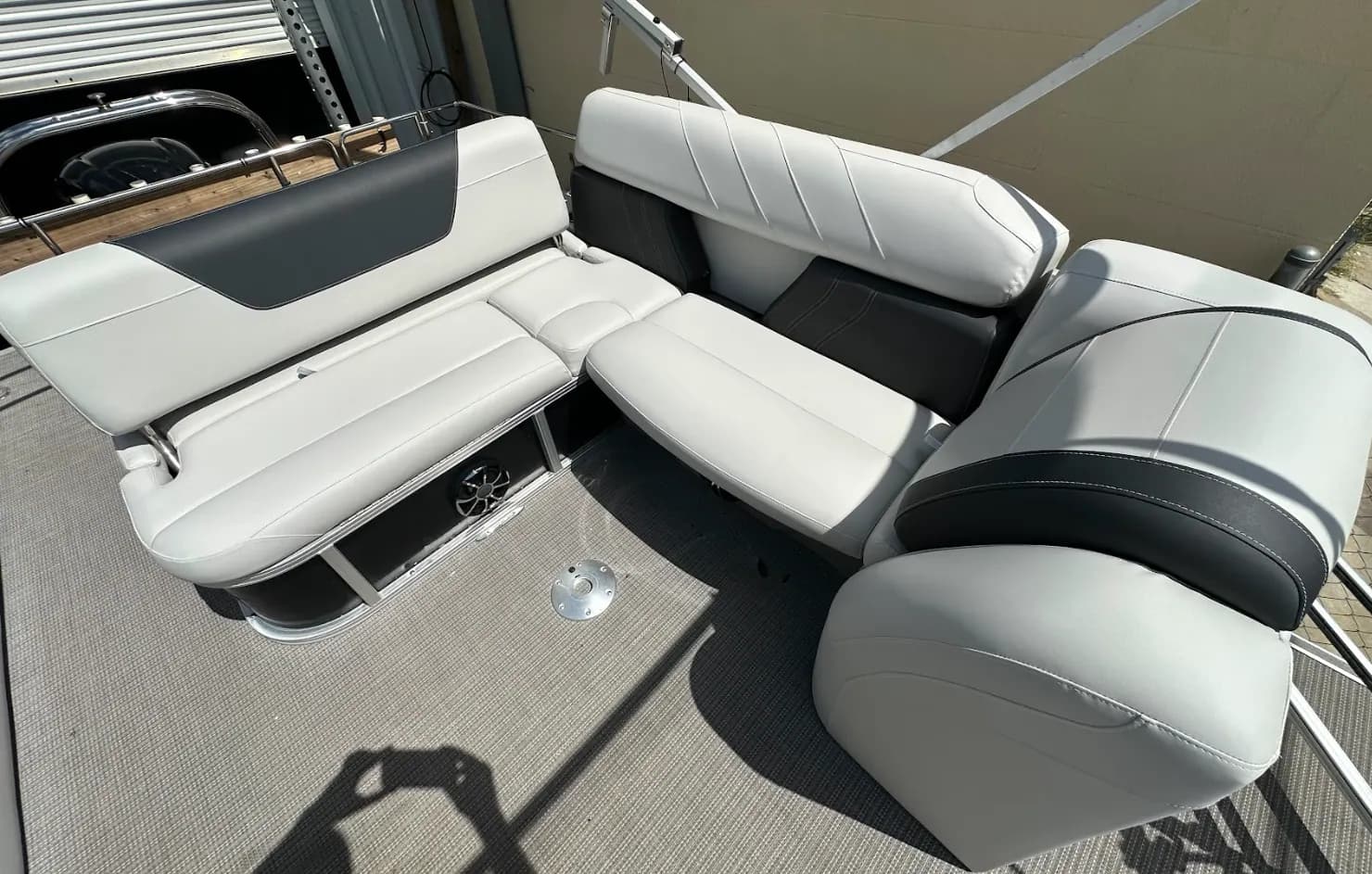
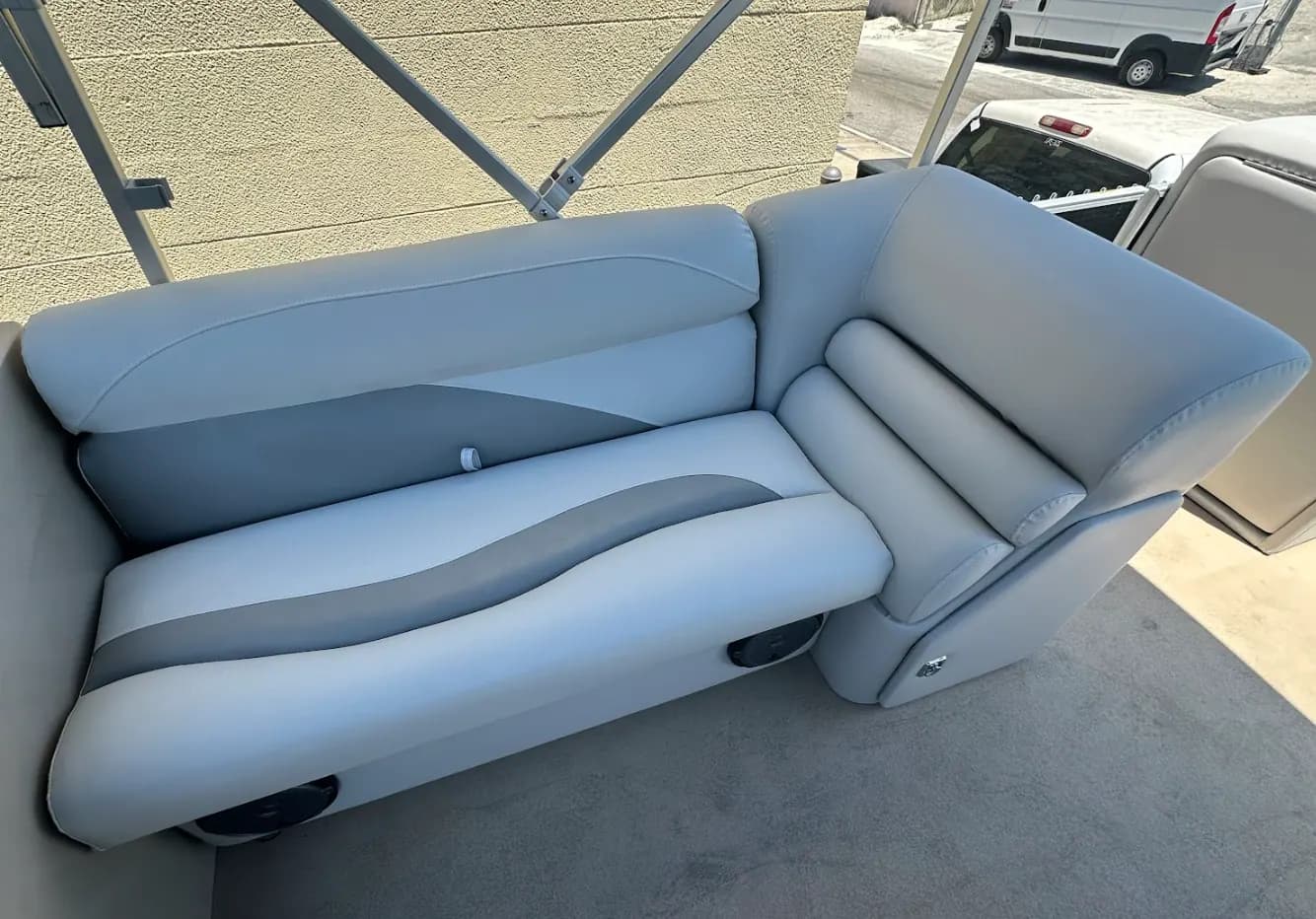
When you recover, you are not limited to OEM colors or styles. You can modernize the whole interior with new marine-grade vinyl colors, contrasting stitching, two-tone panels, diamond stitch inserts or embroidered logos, without starting from scratch. Our StarCraft 2000 restoration is a good example of a boat that came out looking newer than new.
It is often faster
Replacement seats for older boats are frequently back-ordered or discontinued. Boat seat restoration at a local shop means your boat can be back on the water in days for seat work and one to two weeks for a full interior, instead of waiting on parts from across the country or overseas.
You keep the fit
A seat recovered on its original base fits the boat exactly the way the builder intended. Aftermarket seats, even good ones, rarely match the footprint, the swivel height or the hinge position of the originals.
When replacement makes sense
Restoration is the right answer most of the time, but not always. We recommend replacement when:
- the wood base is severely rotted or the plastic frame is cracked or broken
- the seats no longer fit because the layout of the boat has changed
- the seats are cheap aftermarket units with weak structural foam and flimsy bases that are not worth building on
- you want a completely different seat design, such as swapping a bench for a leaning post or adding a flip-up bolster
In those cases we build custom replacement seats to your specifications, including ergonomic improvements and a design that matches the rest of the boat. Even then, the new seat usually reuses or replaces the base and gets the same marine vinyl, foam and stitching as a restoration, so you are not choosing between quality and replacement.
Restore or replace: a comparison
| Recover the seat | Replace the seat | |
|---|---|---|
| Best when | Vinyl, foam or stitching has failed but the base and frame are solid | The base or frame is rotted, cracked or missing, or you want a new design |
| Relative cost | A fraction of replacement, since the base and frame are reused | Higher, especially for OEM or custom seating |
| Fit | Original fit and mounting are preserved | Must be patterned or adapted to the boat |
| Material choice | Full control over vinyl, color, foam and stitching | Full control if custom-built; limited if catalog |
| Timeline | Most seat jobs take days | Depends on fabrication or parts availability; OEM parts may be back-ordered |
| Typical result | Like-new seat with upgraded foam and vinyl | New seat built to spec |
A decision checklist you can run in the driveway
Pull one seat off the boat and go through this list.
- Press the foam. Does it spring back, or does it stay dented and feel wet? Wet or collapsed foam means the foam is done, but that alone does not mean the seat is.
- Flip the base. Is the plywood dark, soft or crumbling? Are staples pulling out with no resistance? Is a plastic base cracked around the mounting holes? Soft or cracked means replace the base.
- Check the frame and hardware. Swivels, hinges and pedestal mounts that are bent, seized or rusted through are a replacement signal. Surface rust on otherwise solid parts is not.
- Look at the vinyl. Cracks, splits and fading are cover problems and are fixed by recovering.
- Smell it. A musty smell with no visible mildew usually means the foam is holding water.
- Ask how you use the boat. If the layout is changing, or the seats never fit well to begin with, replacement may be the better investment.
If the base and frame pass, restore. If they fail, replace the base and recover, or build new. Still unsure? Bring the seat to our shop or send a few photos through the contact page and we will give you a straight answer and a free estimate.
Materials that make a restored seat last
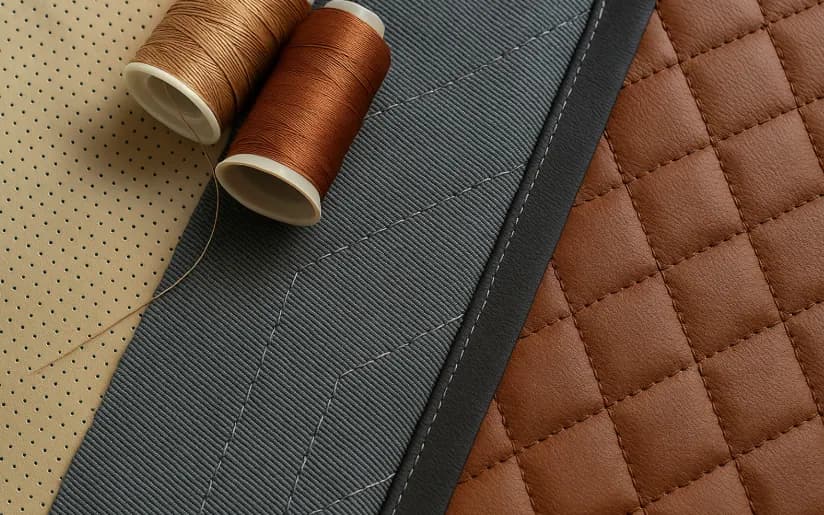
A recovered seat is only as good as what goes into it, and in Florida the material choices matter more than anywhere. We use marine-grade vinyl with UV, mildew and salt resistance, closed-cell or high-density marine foam that does not hold water, UV-resistant thread, and stainless staples and hardware. Our guide to waterproof boat upholstery goes into each of these in more depth.
Marine upholstery restoration in Venice, FL
Our shop at 420 E Venice Ave works on everything from pontoons and center console fishing boats to cruisers and deck boats, for owners across Venice, Nokomis, Englewood, Sarasota, Port Charlotte and Boca Grande. If you are searching for boat reupholstering near you, our boat upholstery services page lays out what we do and how the process works.
High-quality marine vinyl can last 10 to 15 years when it is properly cared for. Restoration does not just improve how the boat looks; it adds real resale value and makes every trip more comfortable.
Get a free quote in Venice, FL
Call (941) 786-4100 or use the contact page for a free evaluation of your boat seats. Bring the seats to the shop, or bring the whole boat; there is trailer parking and a fenced storage lot next door. We will tell you honestly whether to recover or replace, and what each option involves.
- boat seat recovering
- boat seat restoration
- marine vinyl
- replace boat upholstery