Tan Diamond-Stitched Jet Ski Seat
Jet ski seat reupholstery in Venice, FL: a PWC saddle rebuilt in tan marine vinyl with diamond stitching across the whole seat, UV thread and foam backing.
· Updated · 4 min read · Venice, FL
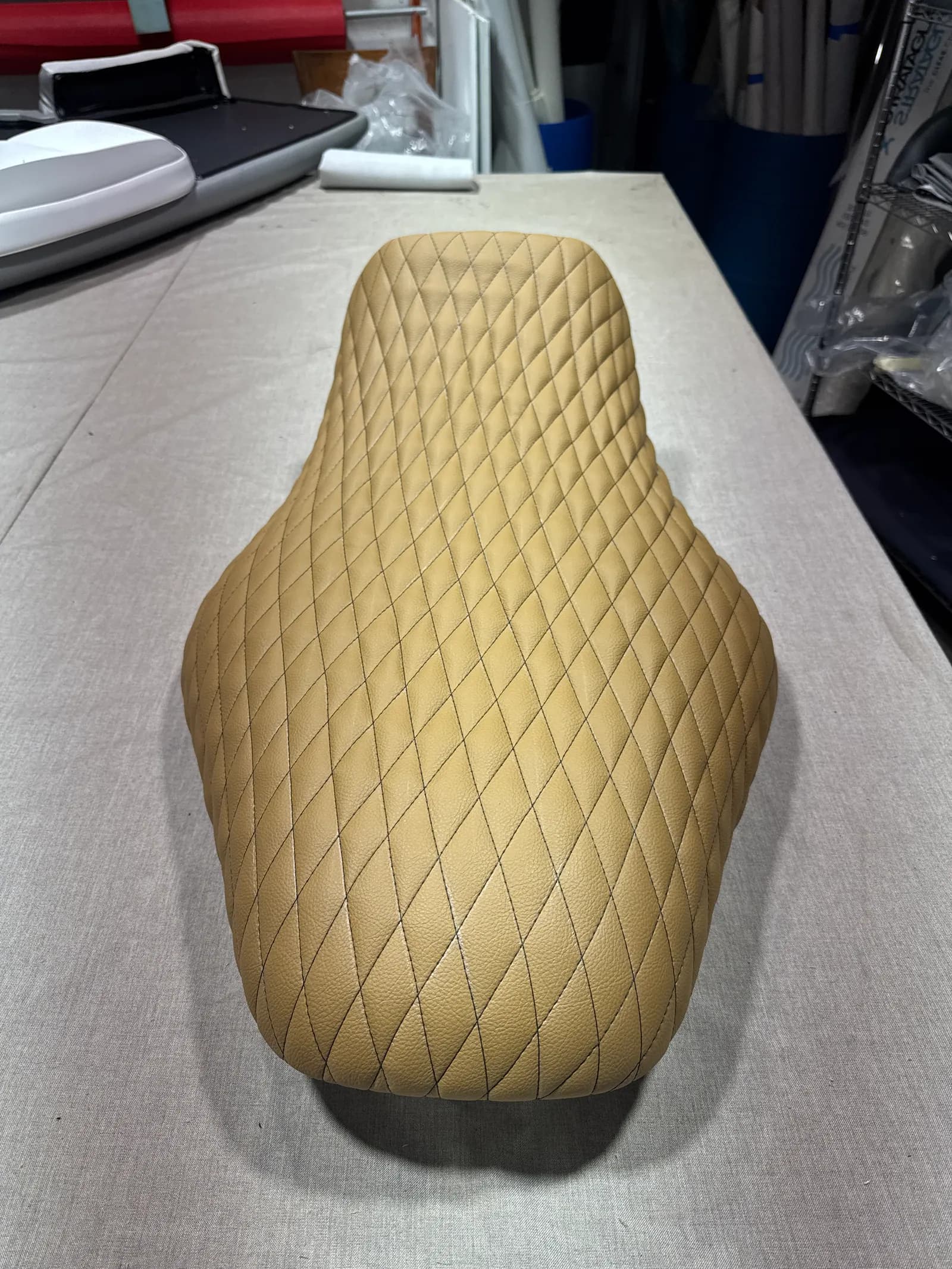
A jet ski seat has a harder life than almost any cushion on a boat. It gets sat on, knelt on and climbed over from the water, then sits on a trailer or a lift in full sun until the next ride. This personal watercraft seat came through our shop in Venice, FL for a full reupholstery and left the bench in tan marine vinyl with a diamond stitch pattern sewn across the whole saddle.
Here is why PWC seats fail, what a diamond-stitched jet ski seat cover involves, and how to make the new one last.
Why jet ski seats fail
There is no shade on a personal watercraft. The saddle is the highest surface on the machine and faces the sky all day, so it takes more UV than a helm seat under a T-top. Sun breaks down the plasticizers that keep vinyl flexible, the cover goes stiff and chalky, and then it cracks at the stress points: the nose, the sides where your knees grip, and the edges where the cover wraps the pan.
Once a seam splits or a crack goes through, water gets in on every ride and every rainstorm. The foam inside a jet ski seat soaks it up and does not give it back. A waterlogged seat is heavy, squelches when you sit on it, and grows mildew inside where you cannot clean it. Wet foam also pushes against the cover from the inside, which opens the split further.
By the time most owners call, the seat is faded, split and waterlogged at once. That is still a straightforward boat seat repair in most cases, because the plastic seat pan underneath is usually fine.
The project: a tan diamond-stitched saddle
This seat was rebuilt in tan marine vinyl with diamond stitching across the entire saddle, not just a center insert. Tan is a practical color on a jet ski. It stays cooler to sit on than black, hides sand and dirt better than white, and fades less visibly than a dark color when the sun eventually gets to it.
Running the diamond pattern over the whole seat is harder than quilting a flat panel. A PWC saddle narrows at the nose, crowns across the top and drops down both sides, so the grid has to wrap a compound curve and still look even from the front, the side and above. The side view in the gallery shows how the rows carry down the flanks of the seat.
What a diamond-stitched jet ski seat cover involves
Foam-backed vinyl
Diamond stitching is not just lines sewn into vinyl. The vinyl is first laminated to a thin layer of foam with a scrim backing, and the stitch lines compress that foam to create the raised diamonds. Without the backing the pattern would be flat and the needle holes would be all you see. The foam layer also gives the saddle a softer, grippier feel.
Pattern layout
Before anything is sewn, the grid is laid out so the diamonds are centered on the seat's centerline and the rows are symmetric left to right. The diamond size is chosen to suit the seat; a pattern that looks right on a wide bench can look crowded on a narrow saddle. Layout is what separates a clean result from one where the rows wander as they go down the sides. We cover the sewing in more detail in our post on diamond stitch boat upholstery.
UV thread and structural seams
Every diamond row is a line of needle holes, and every one is sewn with UV-resistant thread so the stitching does not rot in the sun ahead of the vinyl. The rows sit on the top surface, where water sheds off. The seams that keep water out of the foam are the structural ones where the top panel meets the sides and where the cover wraps the pan, and those are sewn to take the load. Where a seam runs along an exposed edge, a bound edge protects it; we explain that in our post on upholstery tape edge finishing.
Fitting the cover
The finished cover is pulled over the foam and fastened to the seat pan with stainless staples, with the tension worked evenly so the diamonds stay square and the nose does not pucker. Foam that has taken on water is replaced first. A new cover over wet foam only hides the problem for a season.
Caring for a new PWC seat
A diamond-stitched seat has more seams than a plain one, so it is worth a little more care:
- Rinse the seat with fresh water after every ride and let it dry before you cover it.
- Clean with mild soap and water. Bleach, solvents and abrasive cleaners strip the vinyl's topcoat.
- Knock the sand off your feet before you climb on. Sand ground into the stitch lines wears the thread.
- Keep it out of the sun when it sits. A fitted cover is the best protection for any vinyl in Southwest Florida, and we make custom marine covers for watercraft as well as boats.
Get a free quote in Venice, FL
If your jet ski seat is cracked, faded or soaking up water, send us a few photos or bring the seat to our shop at 420 E Venice Ave in Venice, FL. We work with PWC and boat owners across Sarasota, Nokomis, Englewood, North Port and Port Charlotte, and estimates are free. Call (941) 786-4100 or use the contact page to get started.
Project Photos
- jet ski
- PWC
- diamond stitch
- tan marine vinyl
- seat reupholstery