Two Custom Boat Covers: Navy for the Canal Dock, Royal Blue for the Trailer
Two custom boat covers from Venice, FL: a navy mooring cover for a canal-kept bowrider and a royal blue trailerable cover for a deck boat under a carport.
· Updated · 5 min read · Venice, FL
Two recent custom boat covers make a useful pair. One is for a bowrider that lives in the water at a residential canal dock. The other is for a deck boat that lives on its trailer under a metal carport. Both owners wanted the same thing, a fitted cover that keeps the Florida weather off the upholstery, but the boats are kept so differently that the two covers were built to do different jobs.
Same climate, two different problems
In Venice, FL every boat faces the same sun, the same humidity and the same afternoon rain. How the boat is kept decides what the cover has to do about it.
A boat at a dock is exposed on every side and from above. The cover is the only roof it has, so it has to shed rain, stand up to wind off the water and breathe so the interior does not mildew. A boat on a trailer under a carport already has a roof. Its cover is there for what the roof misses: blown rain, dew, dust, pollen, insects and the low sun that comes in under the carport edge morning and evening.
Project A: a navy mooring cover for a canal-kept bowrider
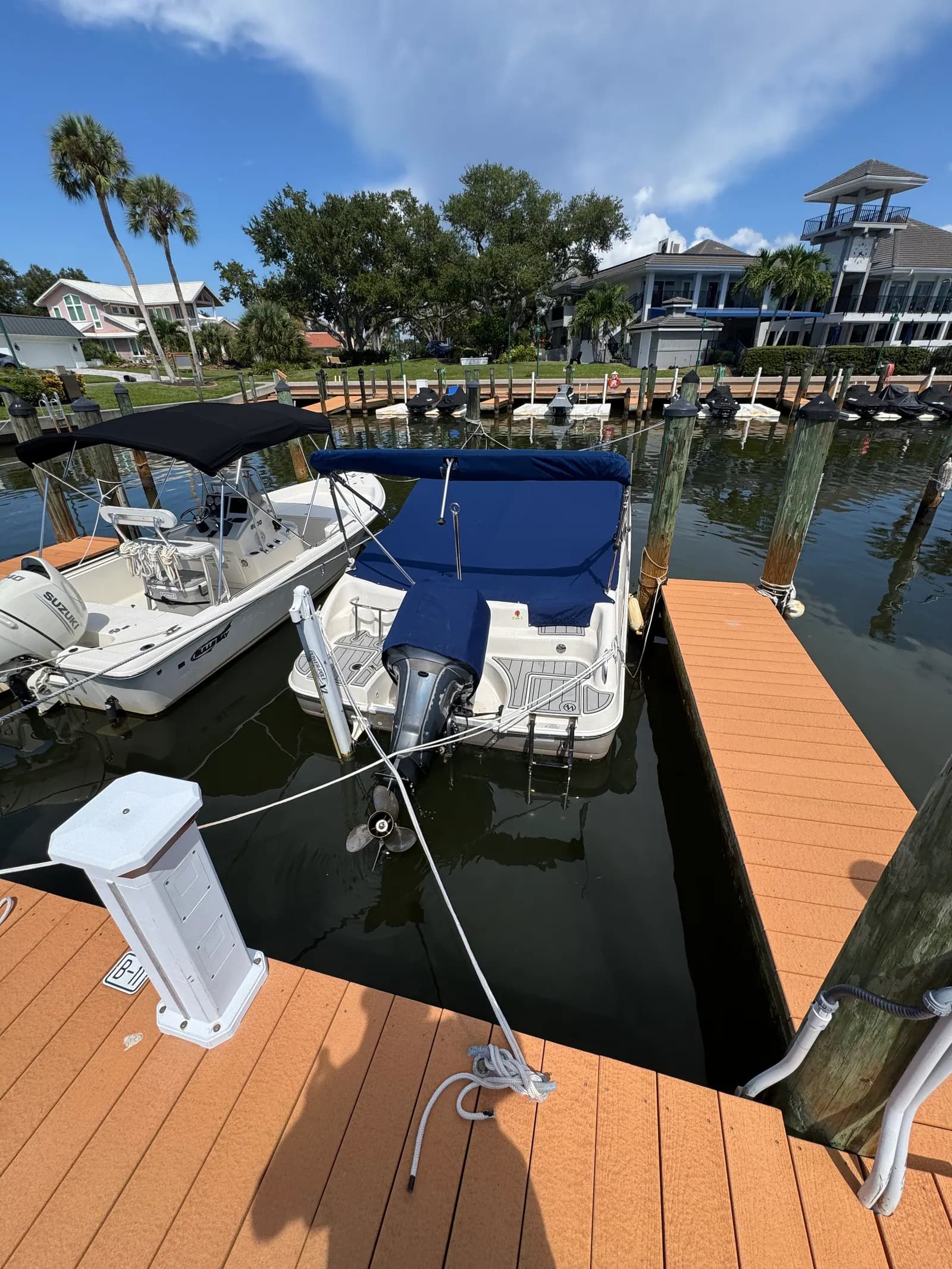
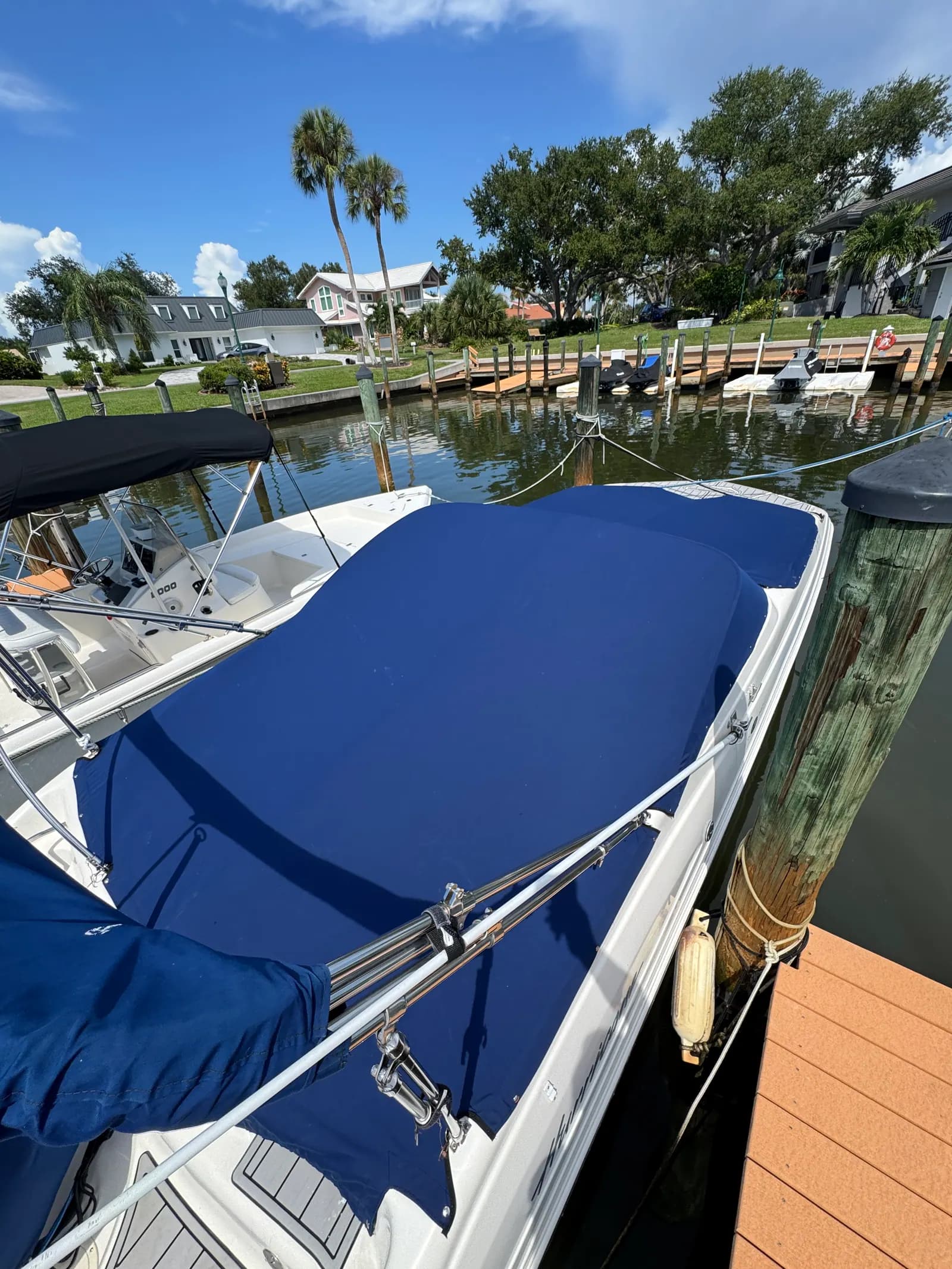
The first boat is a bowrider-style runabout with an outboard and a swim platform finished in foam decking, tied up at a dock on a residential canal lined with houses and palms. It is the classic Venice setup, and the hardest one on an open boat.
In the water there is no shade and no shelter. Rain lands in the cockpit and sits on the seats. Sun works on the vinyl from sunrise to sunset. Pollen and leaf litter from the palms settle on everything, and the morning dew makes sure they stick.
What we built
The mooring cover was patterned on the boat itself. It fits over the windshield and the bow rail and runs aft to cover the whole cockpit, with the outboard and the foam-decked swim platform sitting outside it at the stern. The owner chose navy, a color that looks sharp at the dock and hides dirt between washings.
The cover is held down with straps that pull the edge tight around the hull. On a boat in the water there is nothing else to fasten to, so the straps are what keep the cover from lifting in a gust. The cover is pitched over the windshield so water runs off toward the sides, and vents let the air under it move, which is what keeps a closed-up cockpit from going damp and mildewed.
Project B: a royal blue cover for a trailered deck boat under a carport
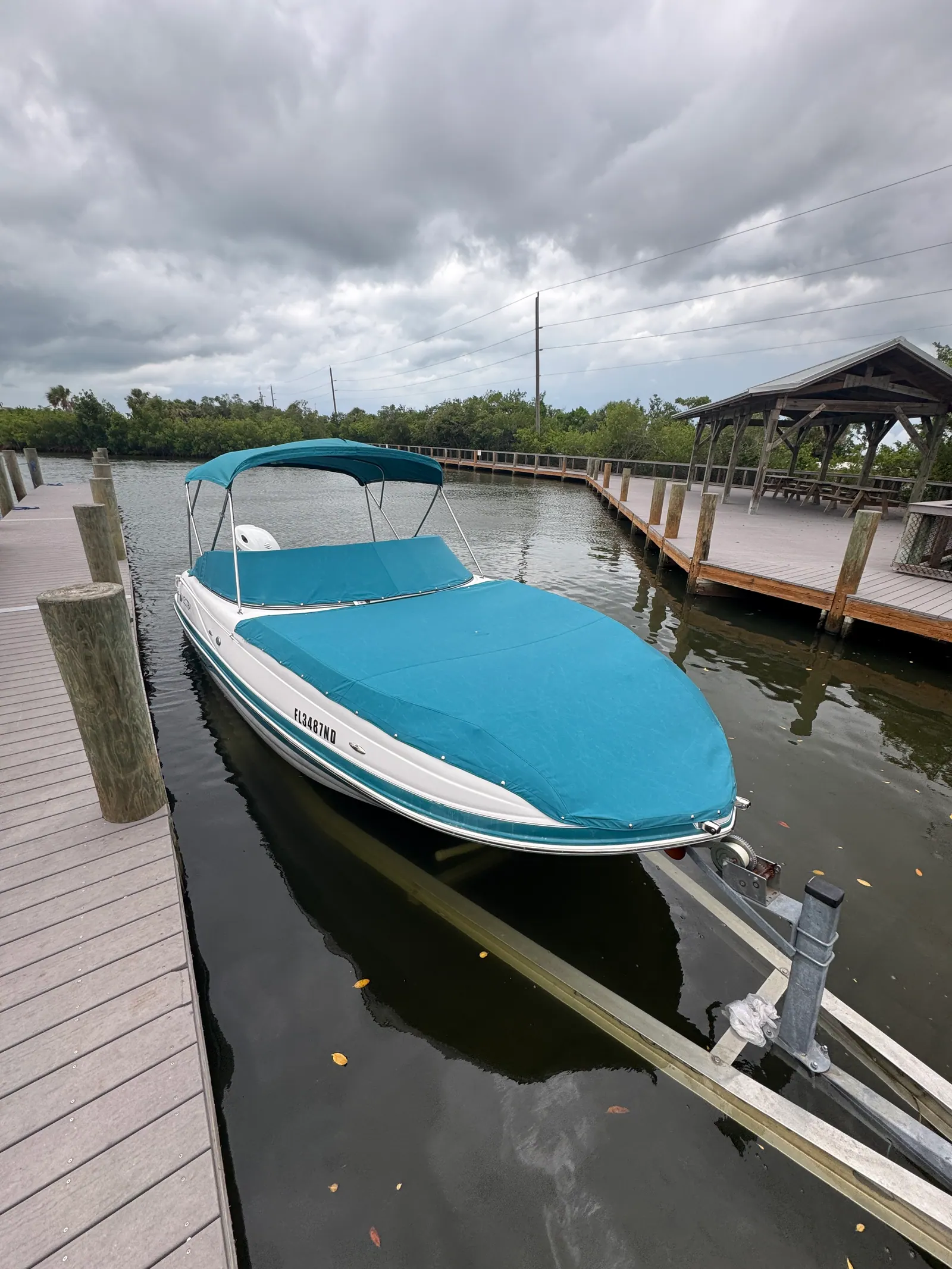
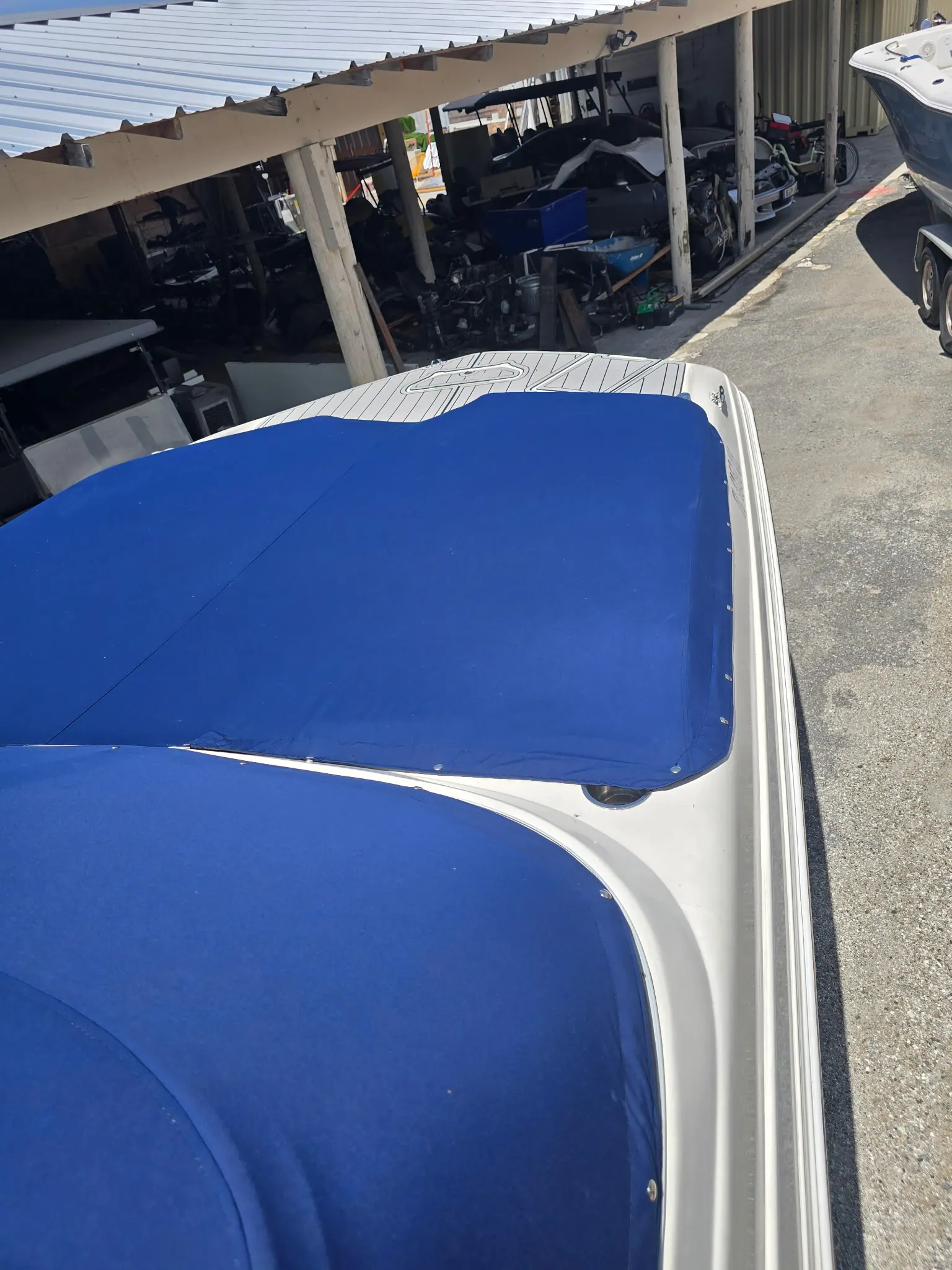
The second boat is a deck boat that stays on its trailer under a metal carport between trips, with its Florida registration numbers on the bow. A carport is a good start: it keeps direct sun and the worst of the rain off, and it is far better than an open driveway. But it is open on the sides, and the low morning and evening sun reaches well under the roof.
What we built
This one is a full cover in royal blue that goes over the windshield and down the sides of the hull. On a trailered boat the cover can be pulled lower and tighter than on a boat in the water, so it fits snug over the windshield frame and along the sides without the sag you see on a universal cover. Adjustable straps keep it that way.
A snug fit matters on a trailer for a reason that has nothing to do with the weather. A loose cover rubs against the gelcoat every time the wind moves it, and over a season that polishes dull patches into the finish. A fitted cover stays still.
What both covers share
Different jobs, same construction standards:
- Both were patterned on the boat they are on, not scaled from a chart of boat lengths.
- Both are sewn from marine-grade acrylic fabric, the Sunbrella type, which is solution-dyed so navy and royal blue stay that color instead of fading to grey, and which breathes so the boat underneath does not sweat.
- Both are stitched with UV-resistant thread, because on the Gulf Coast ordinary thread rots long before good fabric does.
- Both are reinforced at the hard points, such as windshield corners, rail fittings and cleats, where a cover otherwise chafes through first.
- Both use stainless or UV-stable hardware and adjustable straps, so the owner can get the cover tight alone in a couple of minutes.
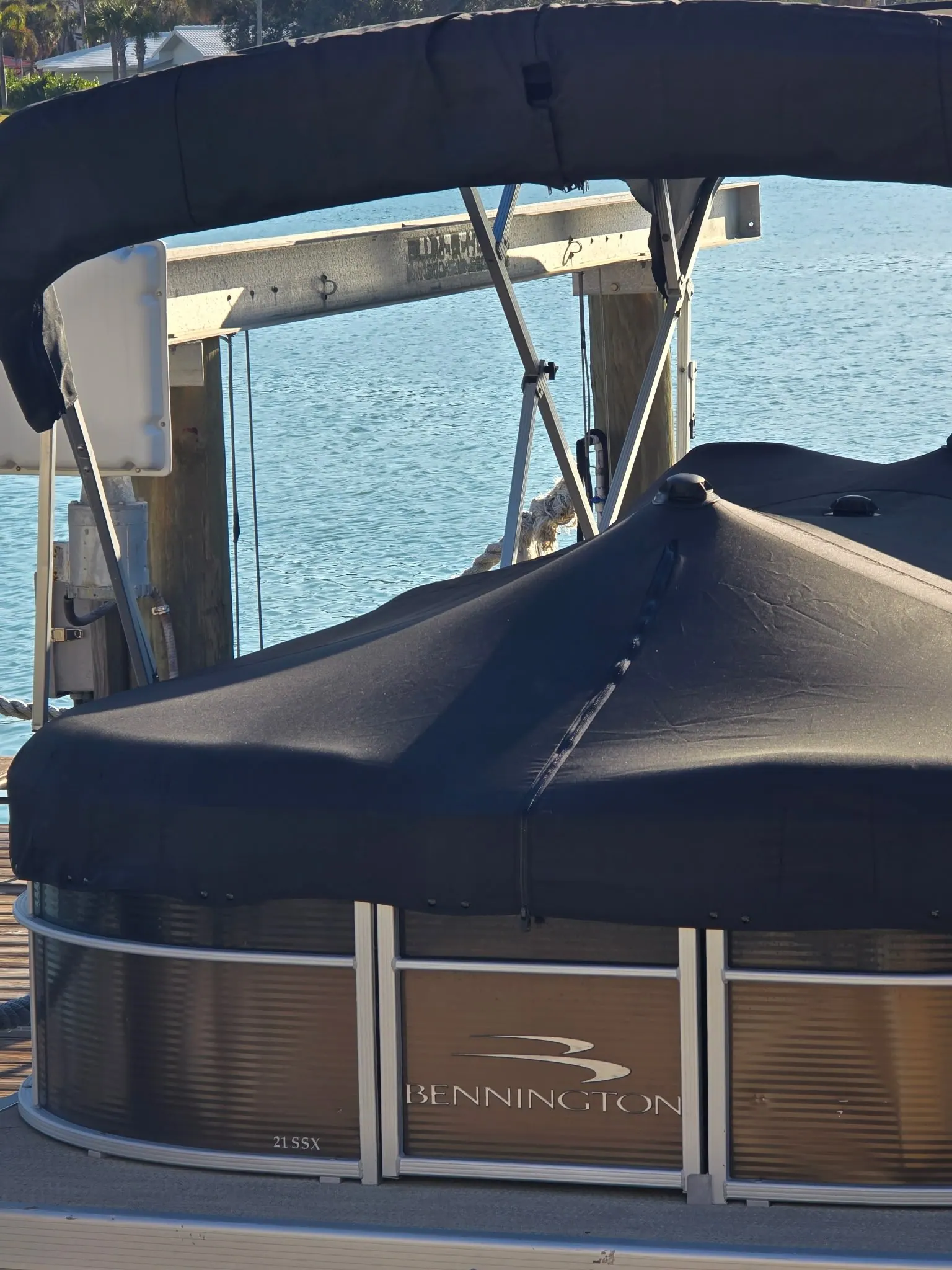
The difference is in the shape, and we went through the same decisions on our Bennington pontoon cover and on the Vectra deck boat with a teal bimini and mooring cover.
Which cover does your boat need
- Kept in the water at a dock: a mooring cover built to shed rain and breathe, with straps as the main hold-down.
- Kept on a lift: a mooring cover, often paired with a boat lift canopy cover that shades the whole boat from above.
- Kept on a trailer, in a carport or a driveway: a full cover drawn down the hull sides. If you plan to tow with the cover on, tell us, because a towable cover needs extra tie-downs and reinforcement to survive highway wind.
Caring for a navy or royal blue cover
Dark colors show pollen and salt streaks sooner than light ones, so they get washed a little more often:
- Rinse with fresh water and brush off pollen before the dew bonds it to the fabric.
- Wash with mild soap and a soft brush, and never with a pressure washer.
- Let the cover dry completely before storing it folded, even for a few days.
- Check the straps, buckles and stress points through the season. A strap that frays or a seam that lifts is a quick repair if you catch it early.
See more fitted covers on our custom marine covers page.
Get a free quote in Venice, FL
Whether your boat lives at a canal dock, on a lift or on a trailer under a carport, we can build a cover that fits it exactly. Call (941) 786-4100 or use the contact page for a free estimate. We serve Venice, Nokomis, Osprey, Englewood, North Port, Port Charlotte and Punta Gorda, and we can measure at our shop at 420 E Venice Ave or at your dock.
Project Photos
- boat cover venice fl
- custom made boat covers
- mooring cover
- trailerable boat cover
- deck boat