Custom Camper Bed Padding: RV Mattress and Cushion Foam Guide
Custom camper bed padding built in Venice, FL: why factory RV mattresses go flat, which high-resilience foam to choose, fabric options and fitting odd shapes.
· Updated · 5 min read · Venice, FL
A long day of driving ends at a camper bed, and if that bed is a thin slab of factory foam, the next day starts badly. Camper bed padding is the difference between waking up ready for the Gulf Coast and waking up with a sore back. We build custom camper bed padding, mattresses and cushions at our shop in Venice, FL for RVs, travel trailers, vans and motorhomes, and this guide covers what goes into one that actually works.
Why factory camper beds go flat
Most camper beds leave the factory with low-density foam chosen for weight and cost rather than sleep. It feels acceptable in the showroom and then loses its shape quickly. Within a season or two the pad is thinner where you sleep and thicker where you do not, the surface is uneven, and the support is gone. The result is restless nights and achy mornings.
Florida makes it worse. Humidity gets into the foam, heat softens it, and constant use compresses it further. A camper that is used every weekend from Venice to the Keys ages its mattress faster than one that sits in a garage up north.
The fix is not a thicker slab of the same material. It is the right foam, cut to the right shape, wrapped in a fabric that handles the climate.
Choosing the foam
Foam is where the comfort is decided. We select it for the bed, the sleeper and the way the camper is used.
High-resilience foam for support
For a bed that is slept on regularly we use high-resilience foam in the HR 40 to 50 range. High-resilience foam pushes back against body weight instead of collapsing under it, and it recovers its shape every time you get up. That is what gives a camper mattress long-term support rather than a few good months.
Gel-infused foam for cooler sleep
Heat buildup is a common complaint in a camper in summer. Gel-infused foam draws heat away from the body and sleeps noticeably cooler than plain foam. It is a popular choice for the top layer of a mattress that will be used in Florida.
Dual-layer builds
A single foam has to compromise between firmness and softness. A dual-layer build does not: a firmer base layer carries the weight and keeps the mattress from bottoming out, and a softer top layer gives the surface comfort you feel first. We match the two layers to the sleeper's preference.
Whatever the combination, the foam should prevent body sinkage, keep heat from building up and hold its shape after months of use. Those three properties are what we design for.
Measuring for curved walls and odd corners
A camper bed is rarely a rectangle. Cab-over beds taper, corner beds are cut on an angle, and van conversions follow curved walls. A store-bought mattress either does not fit or leaves gaps that collect dust and let the mattress shift.
We start every job with the camper's actual layout. Each foam cut is made to the exact size and shape of the sleeping area, including rounded corners and notches for cabinetry. Where the shape is complex, we make a template in the camper first. The finished pad fits the platform without sliding or shifting, which is as important for a good night's sleep as the foam itself.
Beds that lift for storage or fold for travel are built in sections with the splits placed where they will not be felt.
Fabric that handles Florida humidity
The cover is what protects the foam. We wrap camper bed padding in breathable, moisture-resistant fabric that stands up to Florida humidity and the wear of being used on the road. Breathability matters: a cover that traps moisture against the foam leads to the musty smell every camper owner has met at least once.
This is the same thinking we bring to our boat upholstery services, where cushions live in far worse conditions than a camper and still have to stay dry and comfortable. Marine-grade materials and techniques translate directly to RV work.
Covers are made removable so they can be washed or replaced without touching the foam. For families and anyone traveling with pets, that is the feature they end up using most.
Finishing details you choose
Every pad is finished by hand in our Venice workshop, and the details are up to you:
- Stitching color, matched to the interior or used as a contrast
- Zipper placement, positioned where it is easy to reach but not where you sleep
- Corner rounding, to match the platform and keep the cover from wearing at sharp points
- Weight, kept low so pads are easy to lift and remove for cleaning or to reach storage underneath
For a vintage trailer restoration we can match the period look; for a modern RV or van build we keep it clean and simple.
Dinettes, sofas and bunks get the same treatment
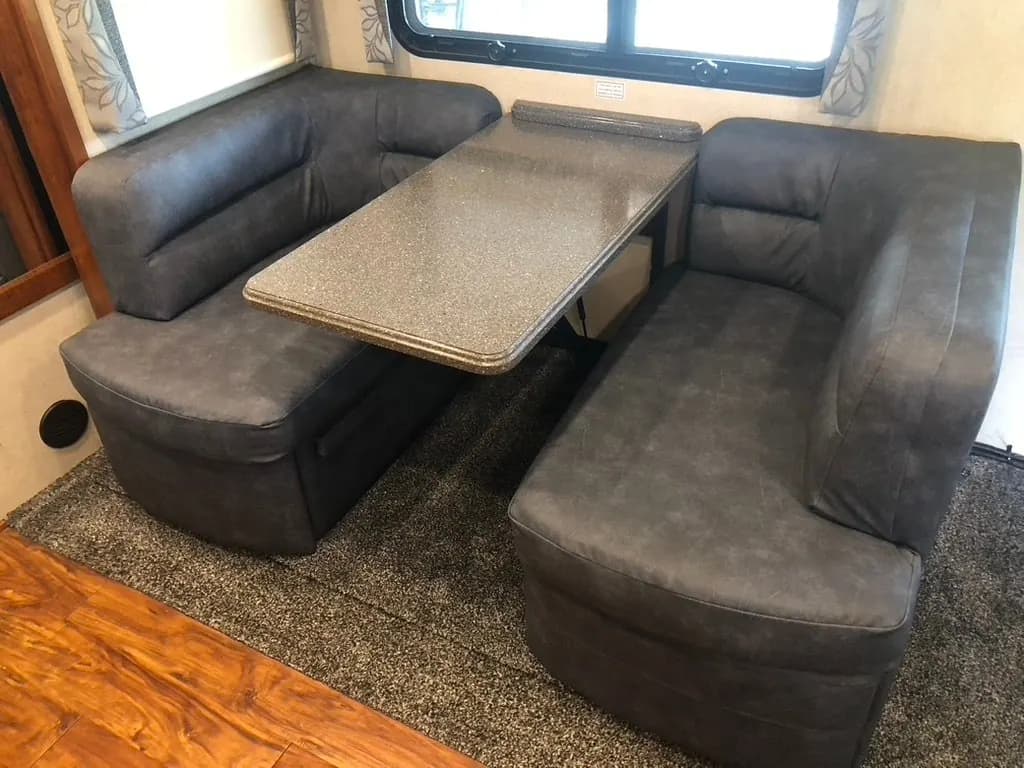
The bed is the biggest cushion in a camper, but it is not the only one that fails. Dinette seats, jackknife sofas and bunk pads are built with the same low-density foam and suffer the same fate, and dinettes that convert into beds have to work in both roles. The grey dinette in the photos above was rebuilt with new foam and recovered in a durable fabric so it is comfortable to sit at for dinner and to sleep on afterward.
Our post on why outdoor cushions go flat and how we fix them goes deeper into foam failure, and most of it applies inside a camper too.
Keeping moisture out of a camper bed
New padding lasts longer with a few habits:
- Ventilate the camper when it is parked, especially after a humid night
- Use reflective window covers to keep cabin heat and condensation down
- Lift the mattress now and then so the platform underneath can dry
- Air cushions out on dry days before the camper goes into storage
If your camper sits between trips, our boat and RV storage lot in Venice next to the shop is fenced and convenient, and it makes it easy to drop the rig off for upholstery work at the same time.
Drop off your RV or camper in Venice, FL
Our shop at 420 E Venice Ave has trailer and RV parking, so you can bring the whole camper rather than wrestling cushions into a car. We build camper bed padding and cushions for owners in Venice, Nokomis, Osprey, Englewood, Sarasota, North Port and Port Charlotte, and for travelers passing through on their way down the Gulf Coast. See everything we work on at our services page.
Get a free quote in Venice, FL
Tell us what you drive, which cushions are giving you trouble and how you use the camper, and we will recommend a foam and fabric combination and give you a free quote. Call (941) 786-4100, email davidk@apogeeupholstery.com, or use the contact page. We are open Monday through Friday, 9 AM to 5 PM.
- camper
- RV mattress
- foam
- cushions